Leadership Skills & Training
Find out how we can support your Leadership & Continuous Improvement Programmes.


Process Management and Agile: Friend or Foe?
Periodically when talking about process management, I will be told “process management isn’t for us, we’re agile”.
Is agile a fair excuse to avoid process management? Short answer, in my opinion, absolutely not; in fact, an agile environment makes process management more important if anything. Here’s why.
Agile and the Agile Trap
First, let’s start by defining agile. While agile originated from software development, it’s since become synonymous with continuous improvement following the Japanese concept of kaizen, which means to make small incremental improvements continuously. The idea is that we should always be looking at the way that we work and seeking to improve rather than blindly performing old, ingrained processes.
With this in mind, it’s easy to see why people categorise agile and process management as two competing ideologies, with the former focusing on change and growth, while the latter prioritises stability.
Let’s consider the SA Partners Improvement Journey:
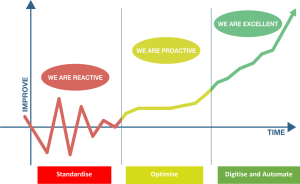
When you are in the reactive phase, you’re likely to be experiencing:
And this can be the agile trap – if you adopt an uncontrolled, ungoverned approach to continuous improvement you run the risk of trapping yourself in the reactive phase with process participants given a license to perform their work differently every time they do it and call it agile.
Process Management
How then does process management come in to save the day? Simply put, it means that we are fostering an environment of continuous improvement, however, tying governance around it.
This starts with standardisation. While it may seem counter-intuitive, for us to improve we need to start from a platform of stability so that we are all trying to improve the same process (see my earlier post where I explore the idea of standardisation in more detail). Once we’ve achieved stability, we’re ready to start thinking about improvement. While yes, we want everyone in the organisation to be empowered to drive change, it’s critical that processes have clearly defined ownership such that while anyone can make a suggestion to change, it is the process owner who makes the decision on if we adopt the change an deviate from our agreed, stablised process.
To make this happen, every process needs to have a clear process owner and expert:
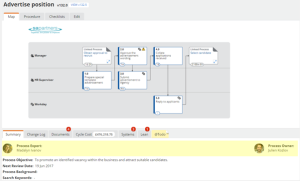
Once this ownership has been defined, anyone should be able to leave feedback on the process to suggest a change, but this feedback needs to be funneled to our process owner and expert to assess the feedback and make a decision on what action, if any, will be taken:

The benefits of tying governance around improvement are:
In summary, process management and agile shouldn’t be seen as competing ideologies rather process management will help you to avoid the agile trap and drive effective, meaningful change.
Digital Transformation Business Manager






Find out how we can support your Leadership & Continuous Improvement Programmes.

Supporting your organisation to achieve Enterprise Excellence.

S A Partners continues to invest in industry research to support our customers.

Supporting your learning Journey - delivering workshops and Shingo Prize guidance